Many rehabilitation facilities face rising operational costs while trying to maintain recovery service quality1. The choice between High-Frequency 3D Vibration Therapy Devices2 and traditional RRT-style systems3 now hinges on long-term ROI, not just initial price tags.
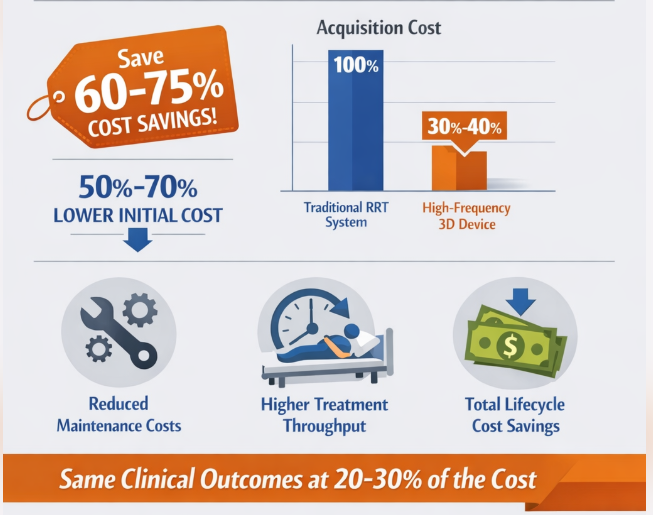
High-Frequency 3D Vibration Therapy Devices2 offer up to 60–70% lower wholesale cost than traditional RRT-style systems3, while maintaining clinical functionality for daily use. Their efficiency in space, utilization, and staffing reduces the true Total Cost of Ownership4, making them a strategic alternative in economic downturns.
These systems are increasingly adopted in wellness centers5, fitness studios, and corporate recovery programs due to their operational flexibility and scalability under budget constraints. The core differentiator lies in how device design impacts throughput and resource use—especially through smart integration of low-impact, high-frequency motion.
Total Cost of Ownership4: Why Upfront Price Doesn’t Reflect Real ROI in Daily Use?
When evaluating clinical equipment, initial purchase price often misrepresents long-term value. High-Frequency 3D Vibration Therapy Devices2 offer a structured cost advantage over RRT-style systems across all ownership phases.
Unlike RRT systems that require dedicated staff and scheduled sessions, High-Frequency 3D Vibration Therapy Devices2 enable self-service use6 with minimal supervision. Their lower acquisition cost—up to 70% below RRT-class units—directly improves capital efficiency7.
| Factor | High-Frequency 3D Vibration | RRT-Style Systems |
|---|---|---|
| Purchase Price (per unit) | 60%–75% lower | Baseline |
| Capital Investment Requirement | Lower upfront investment | Higher upfront cost |
| Ease of Adoption | Minimal training required | Technique-dependent |
| Staff Dependency | Low | High |
| Daily Utilization Potential | High (scalable use) | Moderate (operator-limited) |
| Cost per Treatment | Lower over time | Higher due to labor reliance |
| Service Consistency | Standardized output | Varies by operator |
| Revenue Scalability | Easier to expand service offering | Limited by manual delivery |
This setup cuts over 60% from the Total Cost of Ownership4 over three years. The frequency bandwidth (4500–7500 RPM) and low 2–3.5mm amplitude allow safe, repeat use across broad populations—patients, athletes, office workers—without needing intervention.
Utilization Efficiency: How Device Design Impacts Throughput and Staff Dependency?
Low staff dependency in device deployment directly influences user throughput8 and facility scalability. High-Frequency 3D Vibration Therapy Devices2 are engineered for autonomous operation9, a design shift from traditional RRT systems.
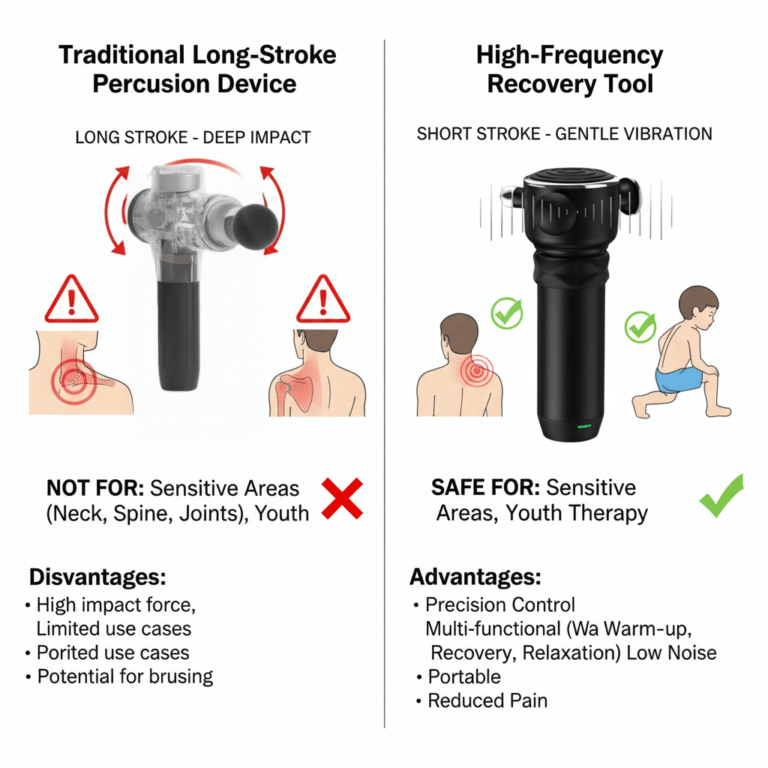
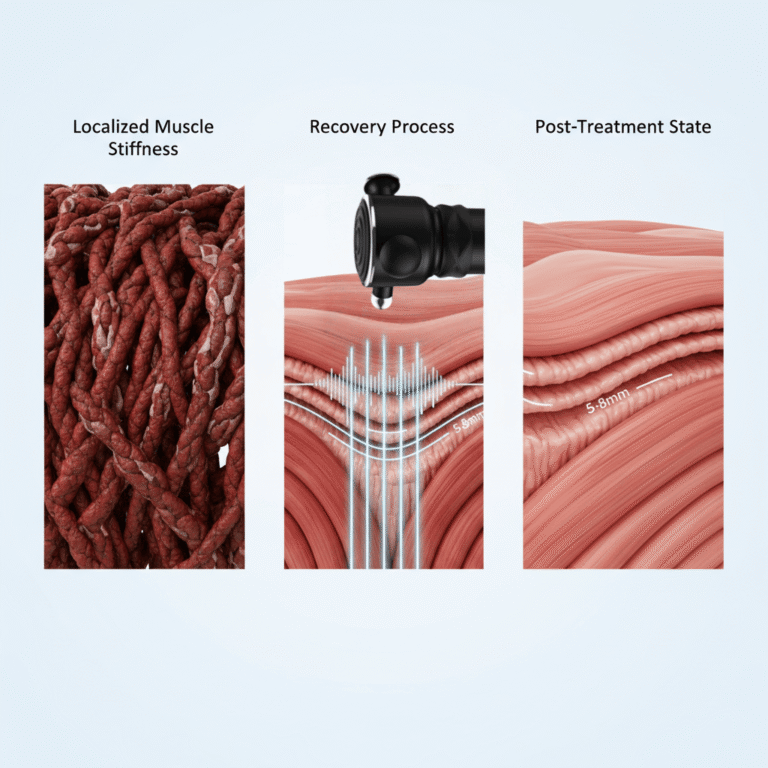
These devices use 3D vibration10—combining vertical pressure and horizontal shearing forces—that replicates manual therapist techniques. This single motion serves both activation and relaxation phases without requiring manual adjustments.
| Design Feature | High-Frequency 3D Vibration Therapy | Traditional RRT-Style |
|---|---|---|
| User Interaction | Self-guided, no guidance needed | Requires therapist oversight |
| Session Timing | 5–10 minutes, no setup | 15–30 minutes, full prep |
| Movement Type | Bi-axial (vertical + lateral) | Unidirectional impact |
| Comfort Zone | All skin types, sensitive areas | Avoids joints, bony prominences |
| Portability | 0.47–0.85kg, foldable chargers | 1.2–2.5kg, fixed mounting |
| Transition Time | Instant switch between modes | Requires kit changes |
The CNC-machined aluminum drive shaft and silent gear system reduce friction-related wear. This extends motor life beyond 2,000 hours—confirming lower downtime. In contrast, RRT systems using high-impact actuators suffer faster degradation when used multiple times per day.
For a clinic processing 30 recovery sessions daily, one High-Frequency 3D Vibration Therapy Device can support 15 users with minimal attendants. RRT units, limited by therapy duration and equipment handoff, cap at 8–10 users per shift.
Positioning & Revenue Potential: Expanding Service Value Beyond Standard Recovery Tools?
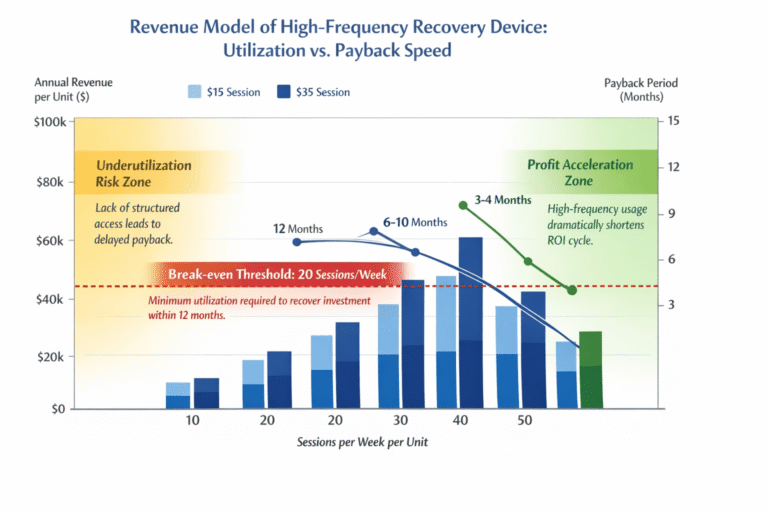
Many facilities view recovery products as cost centers. But High-Frequency 3D Vibration Therapy Devices2 can be repositioned as premium service drivers with clear monetization pathways.
Their 3D motion—mimicking tactile massage—outperforms simple percussion in applications like lymphatic drainage, postural correction, and pre-activity activation. These capabilities open doors to add-on billing, especially in spas, sports clinics, and corporate wellness programs.
| Service Addition | Revenue Model | Margin Potential |
|---|---|---|
| Hourly Recovery Session (Self-Use) | $15–$25/session | 70%+ |
| Corporate Wellness Subscription | $99/month (billed per employee) | 60% |
| Athlete Recovery Retention Package | $199/month, 3–6 sessions | 80% |
| Spa Add-On (Post-Treatment) | $20 extra per service | 90% |
| Fitness Studio Membership Upgrade | Free access at $20/month | 55% |
The integrated single-head design eliminates the need for interchangeable attachments while still enabling targeted application through controlled contact and frequency modulation.
This approach simplifies operation and ensures consistent output across different users. Instead of switching heads, practitioners can adjust intensity and positioning to match user profiles:
- Lower stimulation settings for sensitive or elderly users
- Higher intensity application for athletes or high-load recovery scenarios
By removing attachment dependency, the system supports faster workflow, reduced handling time, and more standardized treatment delivery.
Unlike traditional RRT tools, which are rarely repackaged beyond basic muscle relief, these devices integrate into comprehensive wellness ecosystems. Retailers can bundle them as part of lit-derived experiences (e.g., “Post-Yoga Rebalance Zone”), improving perceived value.
Conclusion
High-Frequency 3D Vibration Therapy Devices2 deliver superior TCO and scalability over traditional RRT-style systems3. Their design enables higher throughput, lower staffing needs, and broader revenue potential11—especially when deployed in self-service recovery scenarios. For procurement managers, the decision is not about price, but about long-term operational efficiency.
-
Learn about the essential elements that ensure effective recovery services. ↩
-
Explore the advantages of these devices in rehabilitation and wellness settings. ↩ ↩ ↩ ↩ ↩ ↩ ↩
-
Learn about the features and limitations of traditional rehabilitation systems. ↩ ↩ ↩
-
Understanding TCO can help you make informed decisions about equipment investments. ↩ ↩ ↩
-
Discover the range of services provided by wellness centers and their benefits. ↩
-
Discover how self-service options can enhance patient recovery and reduce costs. ↩
-
Find strategies to maximize financial resources in healthcare settings. ↩
-
Understand the key elements that affect patient flow and service efficiency. ↩
-
Learn how autonomous devices can streamline operations and improve patient care. ↩
-
Gain insights into the mechanics and benefits of 3D vibration therapy. ↩
-
Explore innovative ways to monetize therapy services and enhance profitability. ↩