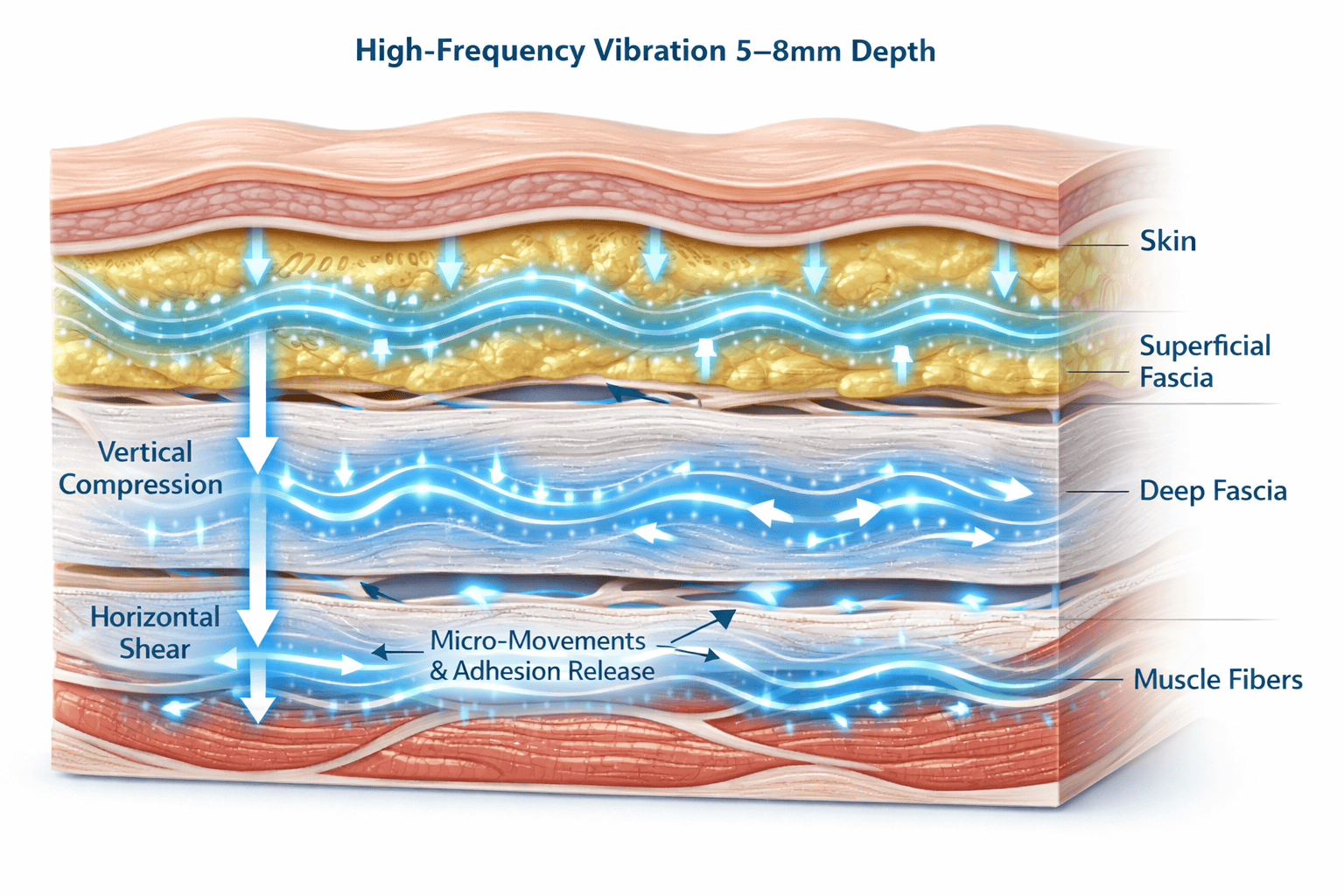
Executive Overview
Fascia has become a central topic in sports recovery discussions, yet most recovery devices are still evaluated using simplified metrics such as force, depth, or amplitude. These measurements are easy to compare but do not necessarily explain how a tool interacts with layered connective tissue systems.
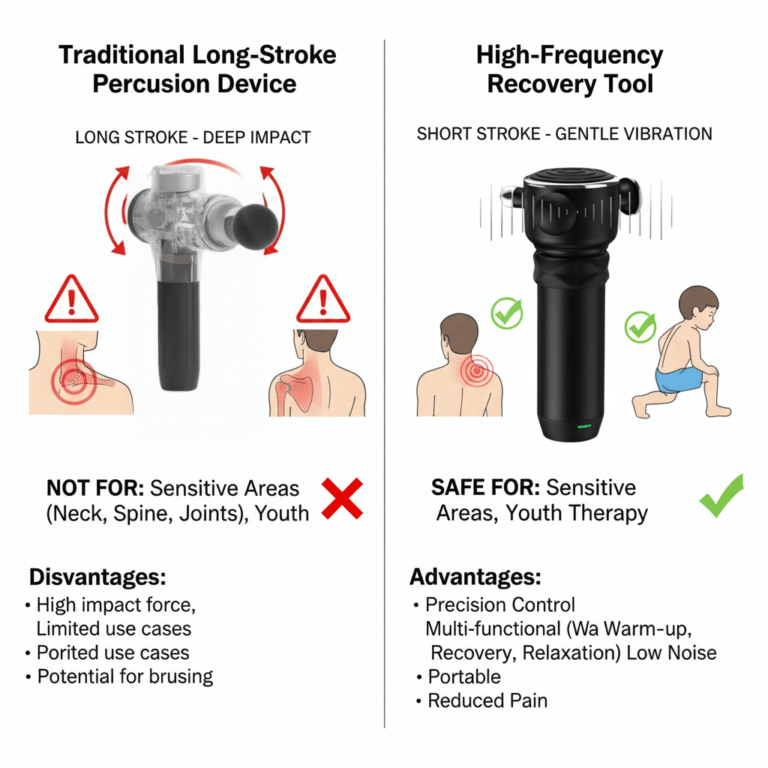
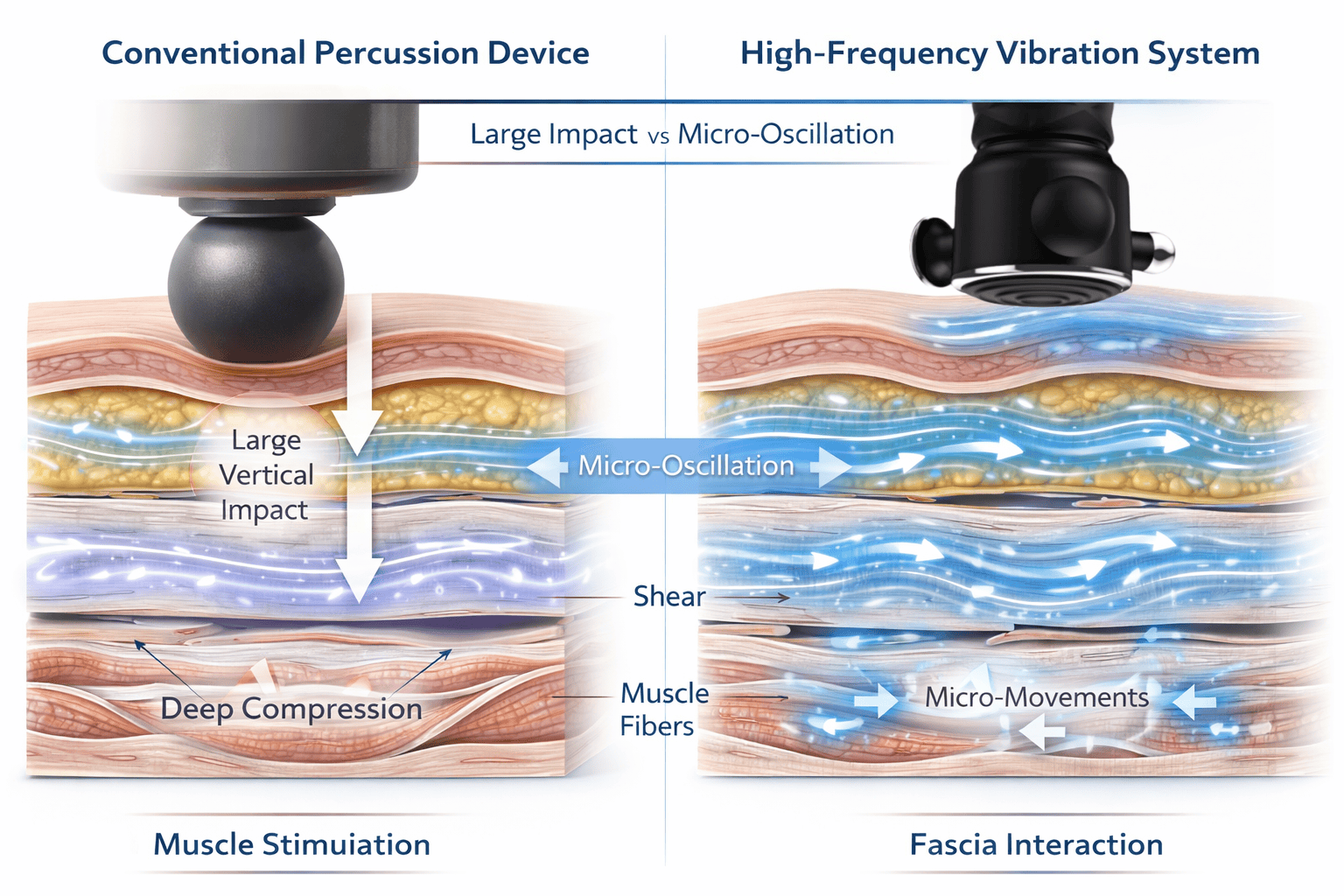
High-frequency vibration technology represents a different mechanical approach. Instead of relying on large impacts, it introduces rapid oscillatory stimulation combined with subtle lateral movement within soft tissue layers.
Understanding this mechanism helps clarify where vibration-based tools can contribute within a recovery environment—and where they should not be expected to replace other methods.
Why Fascia Release Is Often Misunderstood
In many commercial discussions, fascia release is described as a process of applying deep pressure until tissue tension decreases. While pressure can influence muscle tone, fascia behaves differently from muscle tissue.
Fascial networks are designed primarily for:
- Force transmission between muscles
- Elastic energy storage during movement
- Low-friction sliding between tissue layers
Because fascia functions as a sliding interface, purely vertical pressure may not always address restrictions between layers.
Mechanical interaction therefore becomes more relevant than simple force.
Fascia as a Sliding System
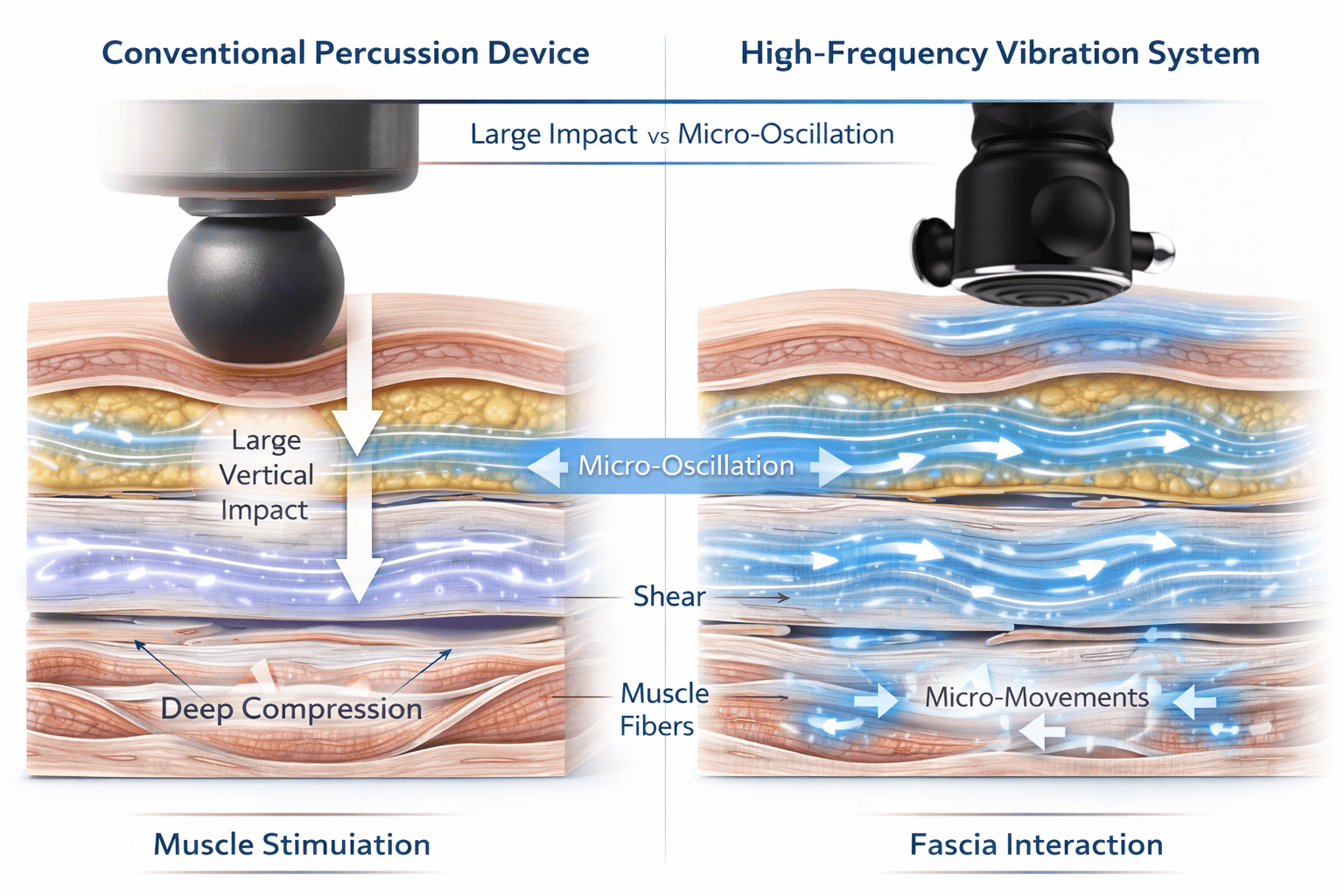
Fascial layers surround and connect muscles throughout the body. Under normal conditions, these layers move smoothly relative to one another during movement.
When sliding capacity is reduced, several functional changes may occur:
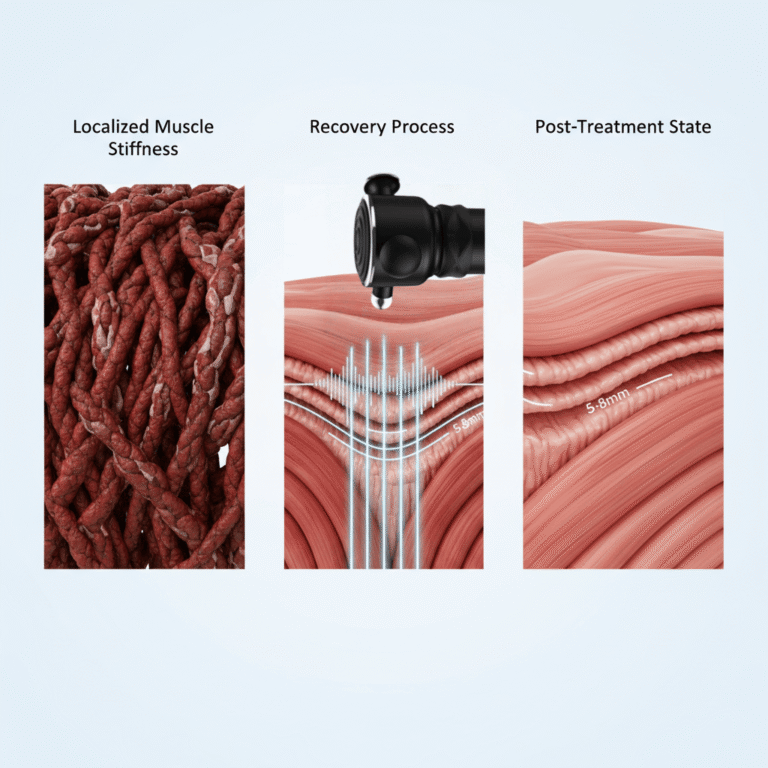
- localized stiffness
- altered movement efficiency
- reduced range of motion
- uneven load distribution across muscles
Many recovery tools stimulate muscles effectively, yet do not significantly influence sliding behavior between fascial layers.
For this reason, some recovery approaches attempt to introduce shear forces rather than compression alone.
Mechanical Interaction Models Used in Recovery Devices
Recovery tools can be better understood by examining how they interact mechanically with soft tissue, rather than by brand category.
| Mechanical Interaction | How It Works | Typical Tools | Primary Tissue Response |
|---|---|---|---|
| Compression | Direct vertical pressure applied to tissue | Foam rollers, manual massage | Muscle relaxation and circulation stimulation |
| Impact Percussion | Repeated high-amplitude strikes into muscle | Percussion massage guns | Neuromuscular stimulation and muscle activation |
| Oscillatory Vibration | Rapid micro-movements transmitted into tissue | High-frequency vibration devices | Continuous tissue stimulation |
| Shear Interaction | Lateral movement between tissue layers | Certain vibration-based systems | Encourages sliding between fascial layers |
Most recovery devices combine several of these interactions. However, the dominant mechanical pattern determines how the tissue responds.
The Principle Behind High-Frequency Vibration
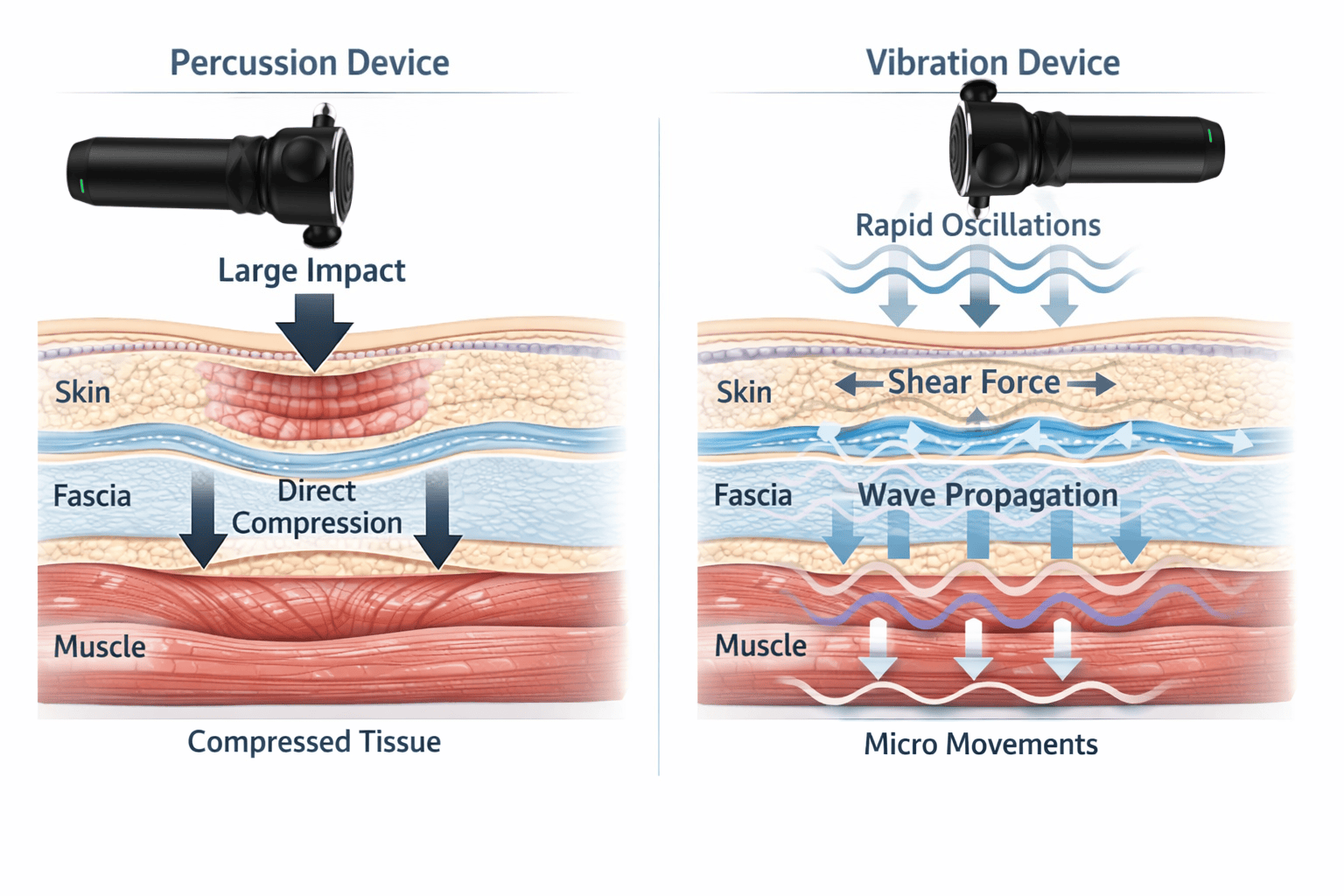
High-frequency vibration systems typically generate rapid oscillations with small amplitude movement.
Instead of large impacts, the device introduces repeated micro-movements that propagate through soft tissue.
Two mechanical components are involved.
1. Oscillatory Penetration
Rapid vibration cycles create mechanical waves that travel through superficial and deeper soft tissue layers.
These oscillations can stimulate tissues without requiring strong pressure.
2. Lateral Shear Movement
Certain vibration systems introduce subtle horizontal movement within tissue layers.
This lateral motion can mimic the kneading effect often used in manual therapy, encouraging tissues to move relative to one another.
The combination of oscillation and shear distinguishes vibration-based systems from conventional percussion devices.
Frequency vs Amplitude in Soft Tissue Stimulation
Recovery devices are often compared using impact depth or stall force, yet these metrics primarily describe percussion tools.
High-frequency vibration systems operate differently.
| Parameter | High-Amplitude Percussion | High-Frequency Vibration |
|---|---|---|
| Movement Size | Larger displacement | Small micro-movement |
| Stimulation Pattern | Intermittent impact | Continuous oscillation |
| Mechanical Transmission | Impact-based | Wave-like propagation |
| Tissue Emphasis | Muscle activation | Localized tissue stimulation |
Higher amplitude does not necessarily translate to deeper or more effective tissue interaction. In oscillatory systems, frequency determines how mechanical waves move through tissue layers.
Potential Functional Effects of Oscillatory Stimulation
When applied appropriately, high-frequency vibration may contribute to several functional responses.
| Observed Response | Possible Mechanism |
|---|---|
| Temporary reduction in perceived stiffness | Repeated mechanical stimulation of soft tissue |
| Increased local circulation | Oscillatory micro-compression cycles |
| Improved readiness before activity | Neuromuscular stimulation and tissue warming |
These responses are context-dependent and should be viewed as supportive rather than therapeutic.
Where High-Frequency Vibration Fits Within a Recovery System
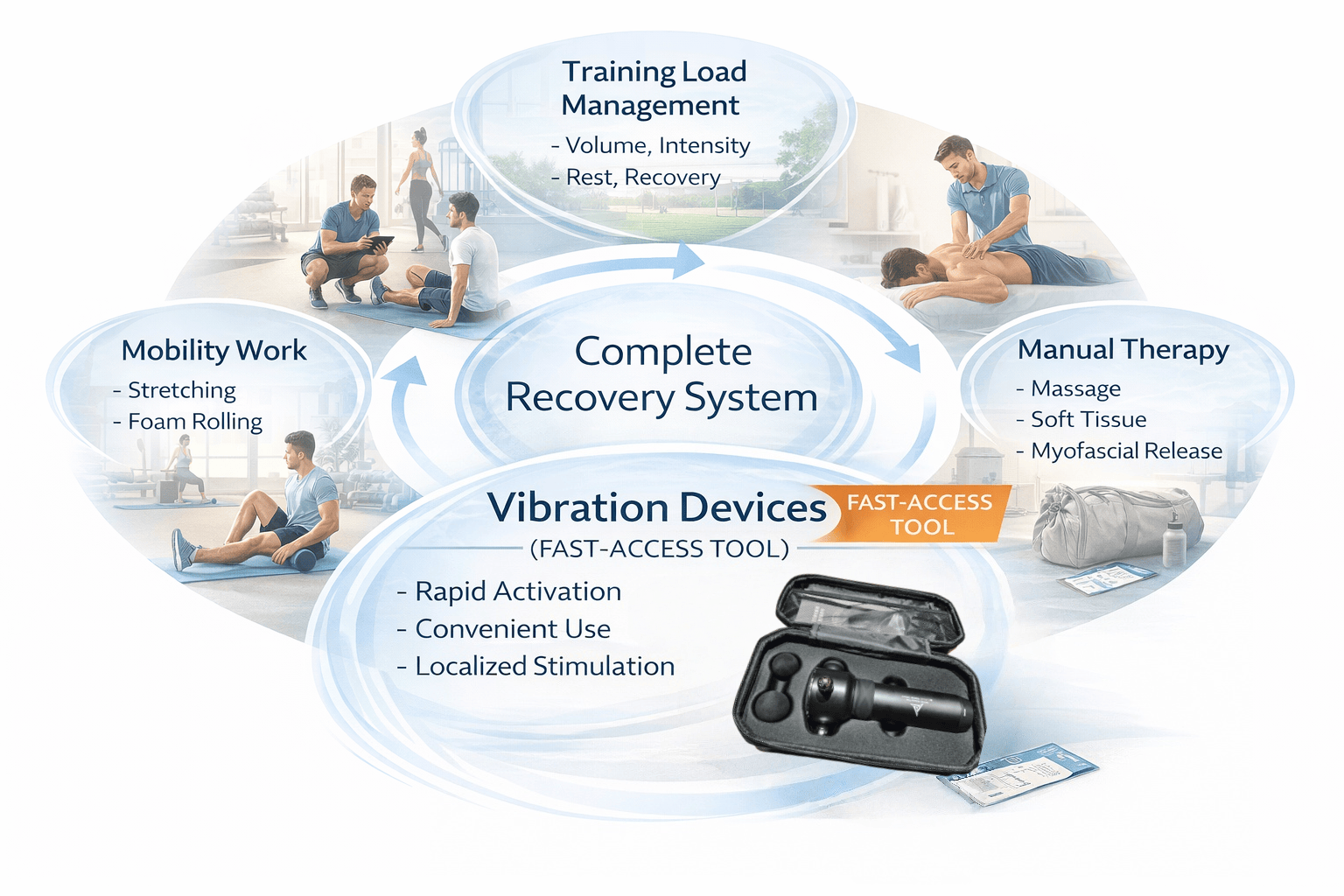
In performance environments, recovery tools rarely operate in isolation. Instead, they support broader systems that may include training load management, mobility work, and manual therapy.
Within such systems, vibration devices are typically used for:
| Context | Reason |
|---|---|
| Pre-training preparation | Rapid stimulation of soft tissue before activity |
| Short-duration recovery sessions | Useful when time is limited |
| Travel or competition environments | Portable support between sessions |
These applications emphasize speed, convenience, and localized stimulation rather than intensive tissue intervention.
Situations Where Vibration Tools Are Not Appropriate
Recovery devices should also be evaluated by their limitations.
| Situation | Why It Is Not Appropriate |
|---|---|
| Acute injuries | Requires medical evaluation |
| Structural tissue damage | Device stimulation cannot replace clinical treatment |
| Rehabilitation without supervision | Rehabilitation protocols require professional guidance |
Defining these boundaries helps prevent recovery tools from being used outside their intended context.
A More Useful Way to Evaluate Recovery Tools
Instead of categorizing devices as “massage tools,” a more practical framework is to evaluate them by mechanical interaction patterns.
Key questions include:
- What type of mechanical stimulus does the device produce?
- Is the stimulus impact-based or oscillatory?
- Does the interaction introduce compression, shear, or both?
Viewed through this lens, high-frequency vibration technology represents a distinct mechanical strategy for interacting with soft tissue systems, rather than simply a variation of traditional massage devices.
Practical Takeaway
Fascia release is often simplified as a matter of applying deeper pressure. However, fascia behaves as a dynamic sliding network, and different mechanical interactions can influence it in different ways.
High-frequency vibration technology introduces:
- rapid oscillatory stimulation
- micro-scale tissue movement
- subtle lateral shear between tissue layers
When integrated appropriately into a recovery system, this approach can support short-duration preparation and localized tissue stimulation.
Its value, however, depends less on the device itself and more on how it is used within a structured recovery environment.