A Technical Guide for Performance Coaches
In many training environments, improving range of motion (ROM) is still primarily addressed through stretching protocols. Static stretching, mobility drills, and manual therapy remain the most common tools used to address mobility limitations.
However, percussion therapy devices are increasingly used in professional training environments. The question for performance coaches is not simply whether percussion therapy works, but what role it plays within a mobility and recovery system.
This guide focuses on three technical questions:
- What mechanism allows percussion therapy to influence range of motion?
- In which mobility limitations does it contribute meaningfully?
- Where are its practical boundaries compared with stretching or manual therapy?
The goal is not to promote a device, but to clarify where percussion stimulation fits within a performance preparation system.
1. Definition: What Percussion Therapy Actually Is
Percussion therapy is a form of mechanical stimulation delivered through rapid oscillatory movements applied to soft tissue.
These repeated impulses introduce vibration and pressure into muscle and fascial layers, producing localized stimulation within the tissue.
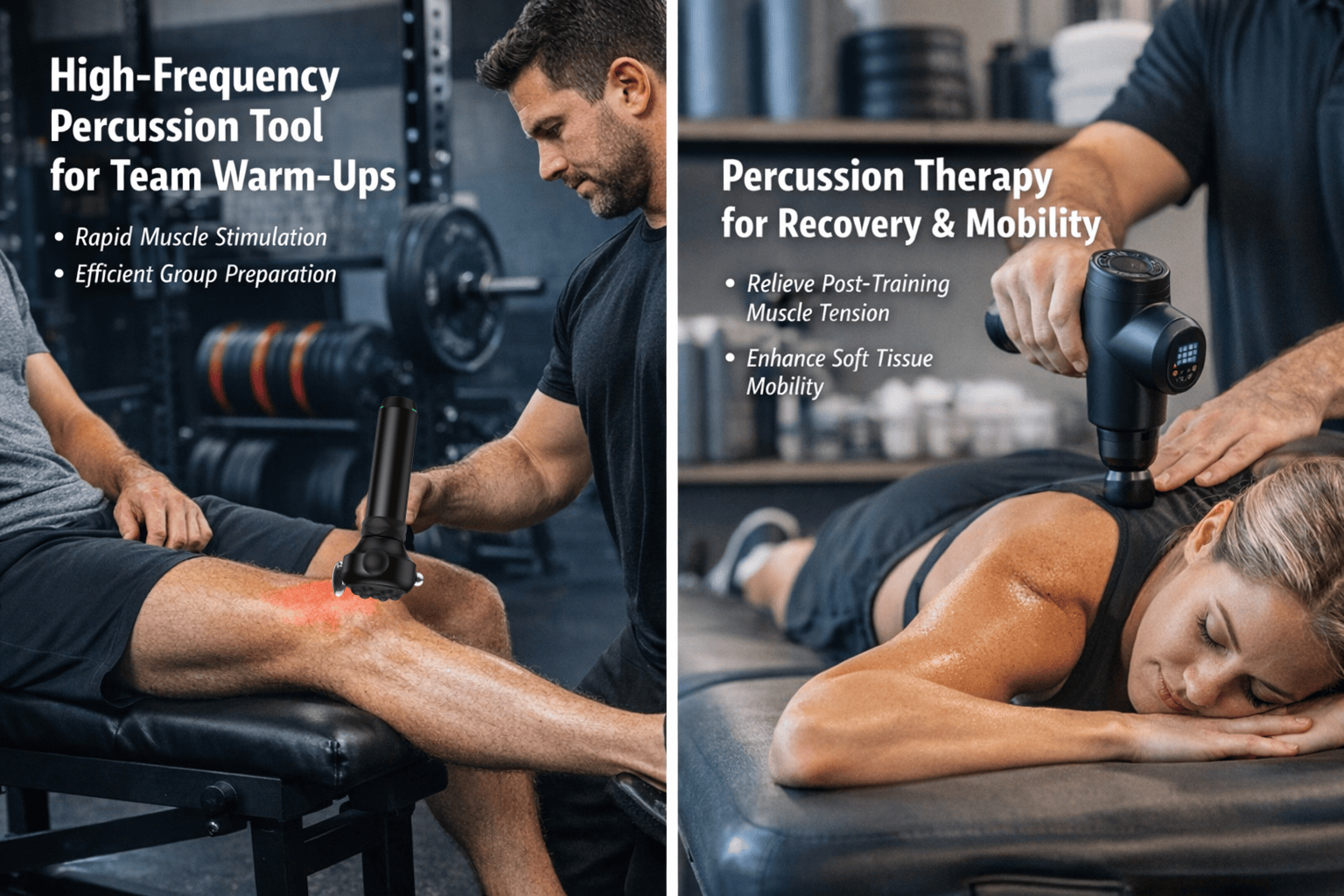
In training environments, percussion therapy is commonly used for:
- muscle tone modulation
- localized soft-tissue stimulation
- movement preparation before training
- post-training recovery routines
It is important to understand that percussion therapy does not directly lengthen muscle tissue.
Instead, its influence on mobility is primarily related to neuromuscular response and soft-tissue behavior.
2. Mechanism 1 — Neuromuscular Tone Modulation
Definition: Neuromuscular Tone
Neuromuscular tone refers to the baseline level of tension maintained by the nervous system within muscle tissue.
Elevated tone often appears after:
- heavy training load
- repeated movement patterns
- localized fatigue
- protective neuromuscular responses
When muscle tone increases, joints may appear to have limited mobility even when structural flexibility is sufficient.
How Percussion Stimulation Influences Tone
Rapid mechanical stimulation may temporarily affect neuromuscular behavior through:
- stimulation of muscle spindle receptors
- altered reflexive muscle activation
- reduced perception of muscle tightness
As muscle tone decreases, joints may temporarily move through a larger range of motion.
Important Boundary
The resulting ROM increase is neurological and temporary.
Percussion therapy helps muscles relax, but it does not permanently change muscle length or joint structure.
Long-term mobility improvements still depend on:
- strength through range
- motor control training
- progressive mobility work
3. Mechanism 2 — Soft Tissue Sliding and Fascial Mobility
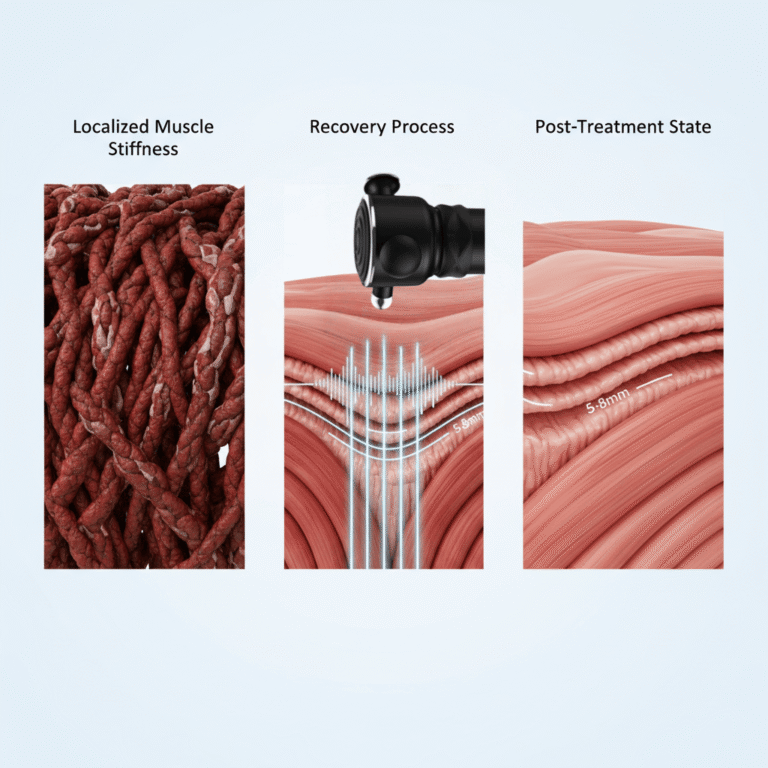
Another common source of mobility limitation is reduced sliding between soft tissue layers.
Muscles and fascia normally glide across each other during movement. Under repeated loading, however, tissue layers may develop:
- localized stiffness
- mild adhesions
- reduced fascial glide
These restrictions do not always respond efficiently to stretching alone.
Why Stretching Alone Can Be Limited
Stretching primarily produces lengthwise tension along muscle fibers.
It has relatively little influence on shear movement between fascial layers.
How Percussion Stimulation Contributes
Oscillatory mechanical stimulation may promote:
- micro-movement between tissue layers
- temporary reduction in localized stiffness
- improved fluid movement within the tissue
This can help restore short-term fascial sliding, allowing joints to move more freely during subsequent mobility exercises.
However, the effect is typically localized and temporary unless followed by active movement.
4. Situations Where Percussion Therapy May Improve ROM
Percussion therapy tends to be most useful when mobility limitations are related to soft-tissue behavior rather than joint structure.
Post-training muscle stiffness
Heavy training can temporarily elevate muscle tone and tissue stiffness.
Short percussion sessions may help reduce localized tightness before mobility exercises.
Localized fascial restriction
Areas such as:
- calves
- quadriceps
- gluteal muscles
- upper back
often develop localized stiffness from repeated loading.
Percussion stimulation may assist in restoring short-term tissue mobility.
Movement preparation
Before training sessions, percussion therapy may assist with:
- tissue readiness
- muscle relaxation
- easier access to movement ranges
In this context, percussion therapy functions as a preparation layer within a warm-up system.
5. Situations Where Percussion Therapy Does NOT Improve ROM
Understanding the limitations of percussion therapy is essential for proper application.
Structural joint restrictions
Range limitations caused by joint capsule stiffness, anatomical blocks, or long-term structural adaptations cannot be resolved through soft-tissue stimulation.
These require targeted mobility work or clinical treatment.
Motor control limitations
Some athletes cannot access available mobility because of poor motor coordination or stability.
Examples include:
- hip mobility limited by pelvic instability
- shoulder mobility limited by scapular control
In these situations, the appropriate intervention is movement training, not additional tissue stimulation.
Pain-driven guarding
When restricted motion is primarily caused by pain, percussion therapy may not be appropriate.
Acute injuries and inflammatory conditions require clinical evaluation rather than mechanical stimulation.
6. Decision Framework for Coaches
When evaluating mobility limitations in athletes, percussion therapy may be useful in specific situations.
| Cause of Limited ROM | Primary Issue | Role of Percussion Therapy |
|---|---|---|
| Elevated muscle tone | Neuromuscular tension | May help temporarily reduce tone |
| Local fascial stiffness | Reduced tissue sliding | May support soft-tissue mobility |
| Joint structure limitation | Capsule or joint restriction | Not effective |
| Motor control deficit | Stability or coordination issue | Not effective |
| Pain-related guarding | Protective response | Requires medical evaluation |
This framework helps coaches decide whether percussion stimulation is appropriate within a mobility intervention.
7. Where a High-Frequency Percussion Tool Fits in a Performance System
For performance coaches and training facilities, percussion therapy is not simply a recovery gadget. Its usefulness depends on how efficiently it can influence soft tissue response within limited preparation time.
In many training environments, coaches face practical constraints:
- multiple athletes in a single session
- limited preparation windows before training
- the need to quickly reduce localized stiffness
Manual therapy techniques can achieve similar results, but they are time-intensive and difficult to scale across teams.
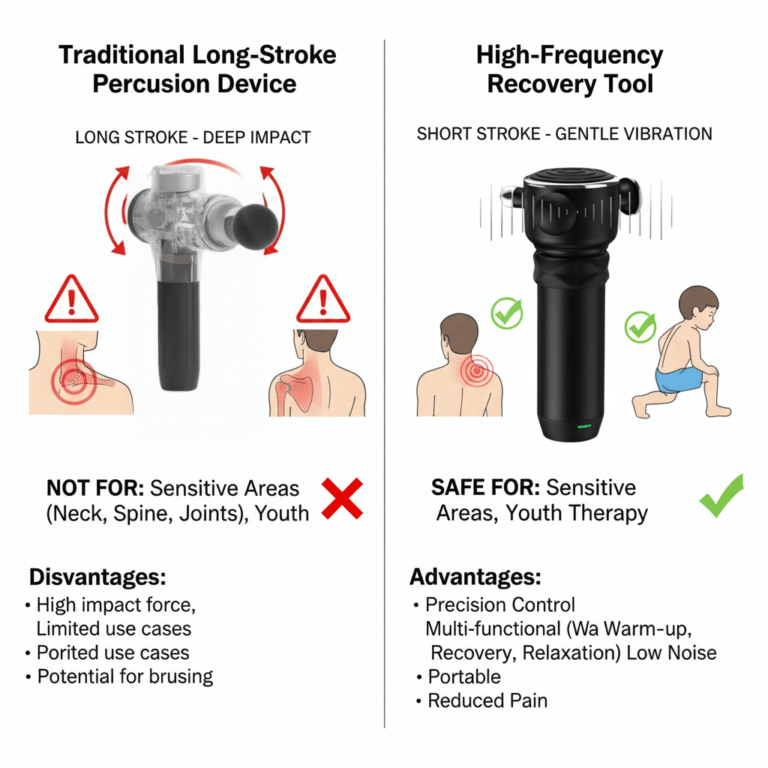
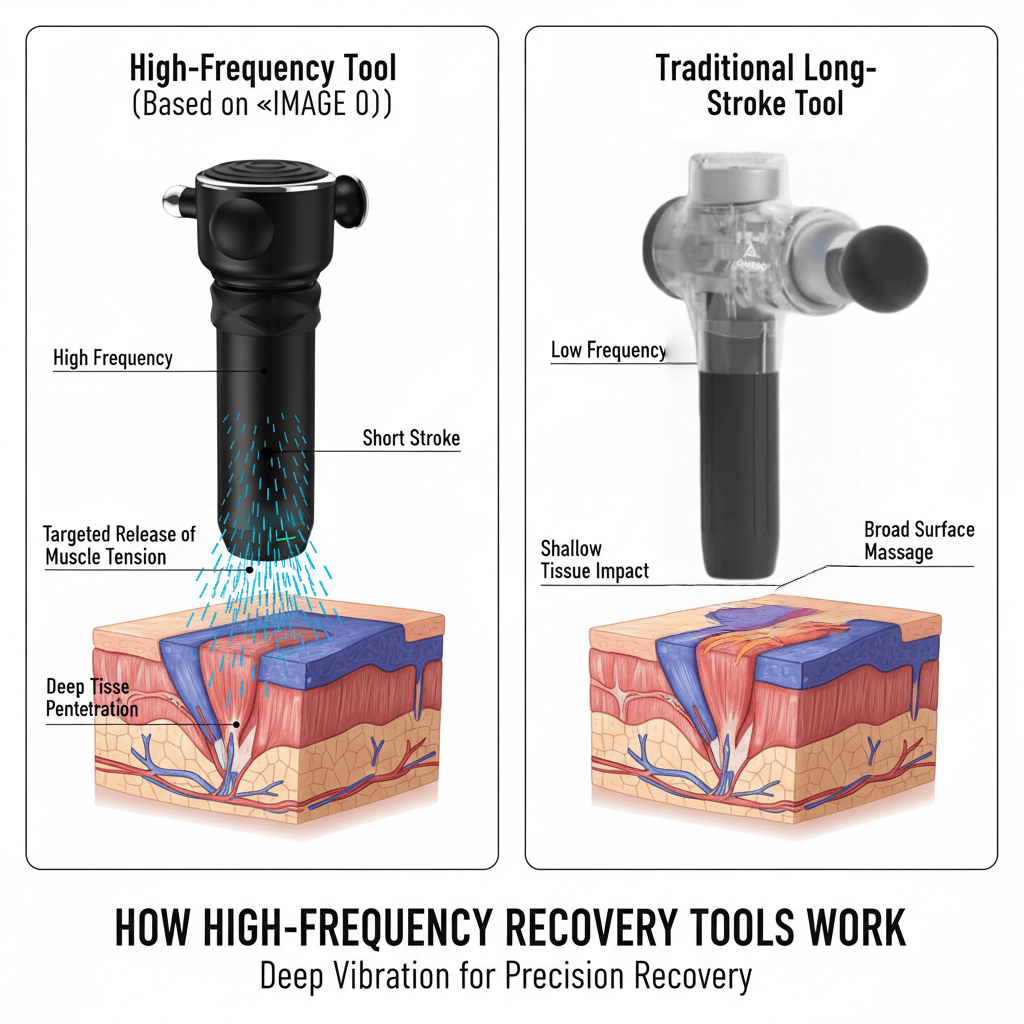
High-frequency percussion tools provide a practical alternative by delivering rapid mechanical stimulation across muscle tissue in a short period of time.
Compared with slower percussion approaches, higher-frequency stimulation may help:
- distribute vibration more evenly across muscle tissue
- stimulate soft tissue more efficiently within short treatment windows
- prepare athletes more quickly before movement training
In environments where multiple athletes must be prepared in limited time, this can allow coaches to scale soft-tissue preparation across an entire group.
8. Where This Tool Is Most Often Used
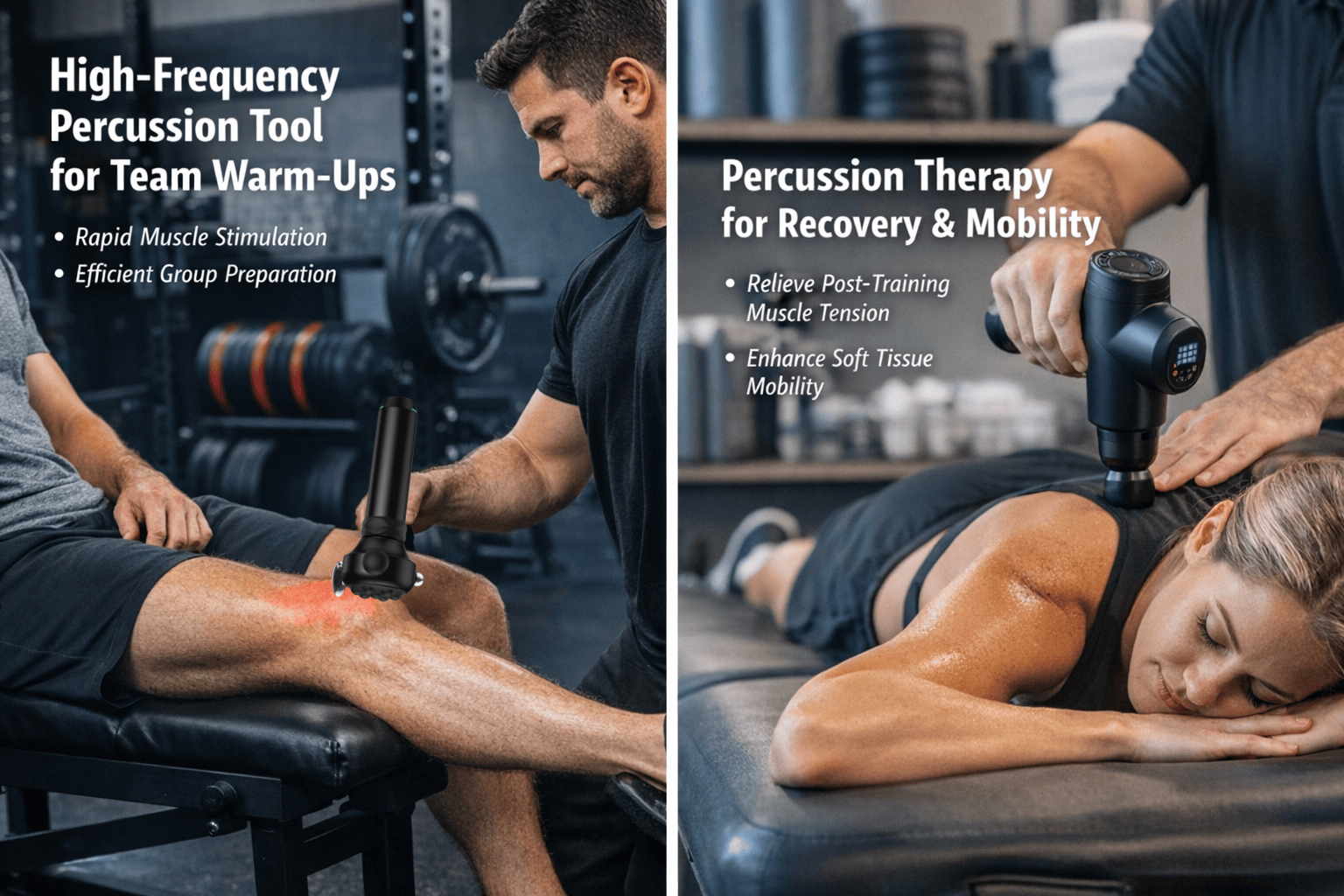
High-frequency percussion devices are commonly integrated into:
- team warm-up preparation systems
- strength and conditioning environments
- recovery stations in training facilities
- athlete self-maintenance routines
Rather than replacing mobility training, the device acts as a preparation layer within the overall recovery and movement system.
Conclusion
Percussion therapy can contribute to improved range of motion primarily through two mechanisms:
- temporary reduction of neuromuscular tone
- improved sliding between soft tissue layers
However, it does not address mobility restrictions caused by:
- structural joint limitations
- motor control deficits
- pain-related guarding
For performance coaches, the value of percussion therapy lies in how it is integrated within a broader movement and recovery system, rather than in the device itself.
When applied appropriately, percussion stimulation can help athletes access movement ranges more efficiently during preparation and recovery routines.