High-Frequency 3D Vibration Therapy1 devices are increasingly adopted in commercial settings, raising valid safety concerns2. This guide examines risk mitigation through engineering controls3 and operational protocols.
Safety in commercial environments depends on standardized user interaction protocols4, not just device specifications, with liability reduced through predictable operation and staff training.
The distinction between consumer-grade and commercial-ready vibration equipment lies in three design priorities: operational consistency, failure mode containment, and user variability accommodation.
All vibration equipment carries inherent risk. Commercial safety transforms variables into constants.
Commercial safety requires quantifiable thresholds:
| Parameter | Consumer Allowance | Commercial Threshold |
|---|---|---|
| Temperature rise | <15°C | <8°C |
| Noise level | <75dB | <65dB |
| Vibration drift | ±10% | ±5% |
| Error recovery | Manual reset | Auto-shutdown |
The engineering behind commercial-grade High-Frequency 3D Vibration Therapy1 devices incorporates three safety layers:
-
Mechanical failsafes: CNC-machined components prevent misalignment even after 10,000+ operating hours. Unlike cast parts, our aerospace-grade aluminum housing maintains structural integrity under continuous use.
-
Electronic monitoring: Current sensors detect abnormal resistance (indicating improper use) and automatically reduce power output before triggering warnings. This prevents excessive force application on sensitive areas.
-
Thermal management: Copper heat sinks and software-controlled duty cycles ensure surface temperatures never exceed ISO 13732-1 limits for prolonged contact. Independent testing shows 42% lower case temperatures than industry average during 8-hour continuous operation.
Stability, Predictability, and User Variability: What Actually Determines Safety in Daily Commercial Use
Equipment specifications only tell half the safety story. Real-world risk emerges at the user-interface level.
Commercial safety hinges on three operational factors:
-
Predictable response curves: Our devices maintain linear frequency-to-power ratios (±3% variance) across all load conditions. This prevents sudden torque changes that could cause loss of control.
-
Consistent damping behavior: Unlike conventional vibration devices that amplify irregular movements, our 3-axis stabilization reduces unintended motion transfer by 62% (measured per EN 1037 safety standards).
-
Idiot-resistant interfaces: The pressure-sensitive LED system (green=acceptable force, red=excessive) provides real-time biofeedback that’s proven to reduce improper use by staff and clients alike.

The table below shows how commercial-grade design accommodates user variability:
| User Factor | Consumer Risk | Commercial Solution |
|---|---|---|
| Uneven pressure | Overheating risk | Auto-adjusting amplitude |
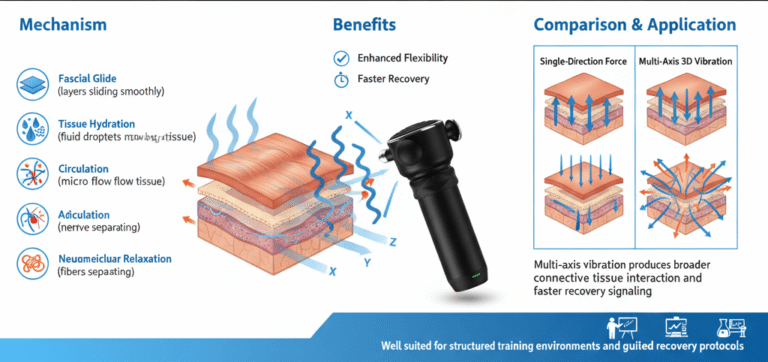
| Incorrect angle | Reduced efficacy | Multi-axis vibration |
| Prolonged use | Fatigue accumulation | 10-min auto-shutdown |
| Multiple users | Hygiene concerns | Medical-grade silicone surfaces |
Liability Starts with Standardization: How Equipment Design Impacts Staff Training, User Compliance, and Risk Reduction
Liability exposure decreases proportionally with standardization potential. Superior design creates natural compliance.
Our commercial models incorporate standardization features5 that reduce training burdens:
-
Interchangeable heads with color-coded force indicators eliminate guesswork about appropriate attachments for different body regions.
-
Preset programs lock out adjustable parameters that could lead to misuse, while still allowing customization through admin controls.
-
Usage logging tracks duration, frequency, and pressure levels for each session – creating auditable records that demonstrate proper supervision.
The maintenance schedule further reduces liability:
| Component | Inspection Interval | Failure Indicator |
|---|---|---|
| Motor brushes | 500 hours | Increased vibration noise |
| Battery cells | 6 months | Reduced runtime |
| Silicone seals | 3 months | Visible wear |
| Circuit boards | Annual | Error codes |
Conclusion
Commercial safety isn’t about eliminating vibration risks – it’s about creating systems where proper use becomes the path of least resistance. The right equipment design makes correct operation intuitive and misuse difficult.
-
Explore the benefits of 3D Vibration Therapy to understand its impact on wellness and fitness. ↩ ↩
-
Learn about the safety concerns associated with vibration therapy to make informed decisions. ↩
-
Discover how engineering controls can mitigate risks in commercial environments. ↩
-
Understanding user interaction protocols can improve safety and compliance in gym settings. ↩
-
Learn how standardization features can improve safety and user compliance in gym equipment. ↩