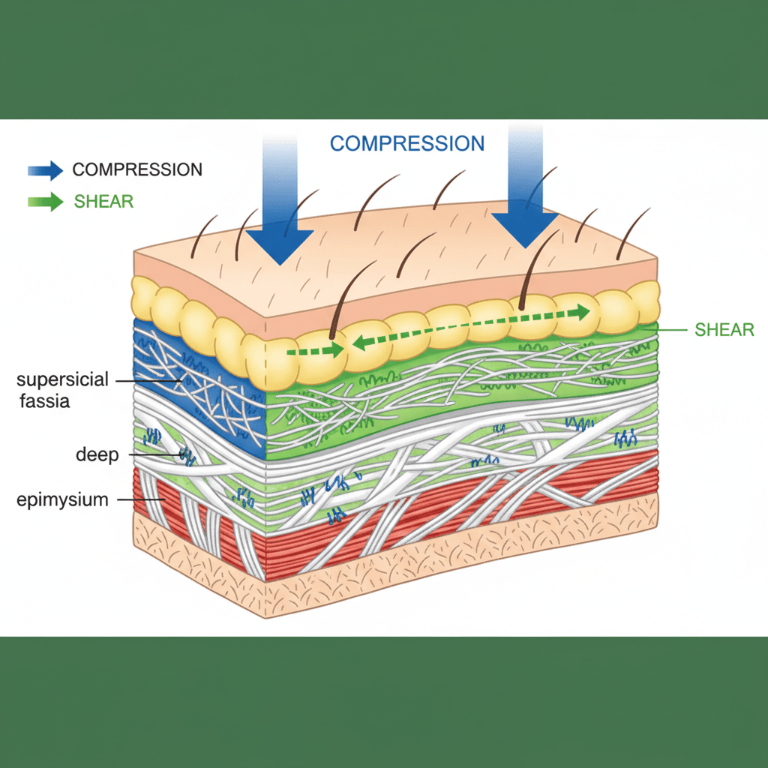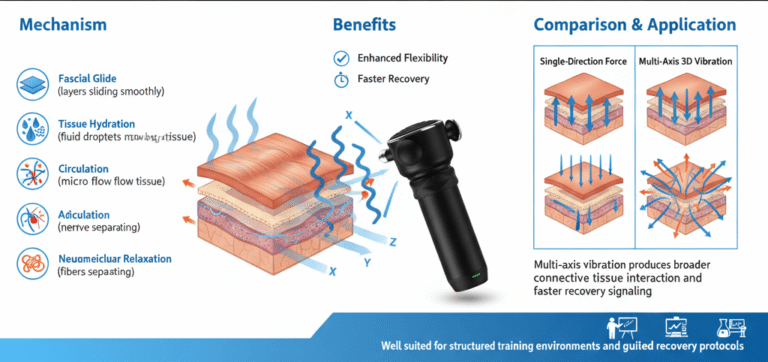
High-Frequency 3D Vibration Therapy1 at 100Hz+ redefines warm-up efficiency. Unlike traditional methods, it delivers rapid tissue activation without excessive force.
High-frequency vibration above 100Hz achieves faster muscle preparation by optimizing kinetic energy transfer2 while minimizing mechanical stress on tissues. This frequency range triggers rapid muscle fiber recruitment through neural pathways rather than brute-force percussion.
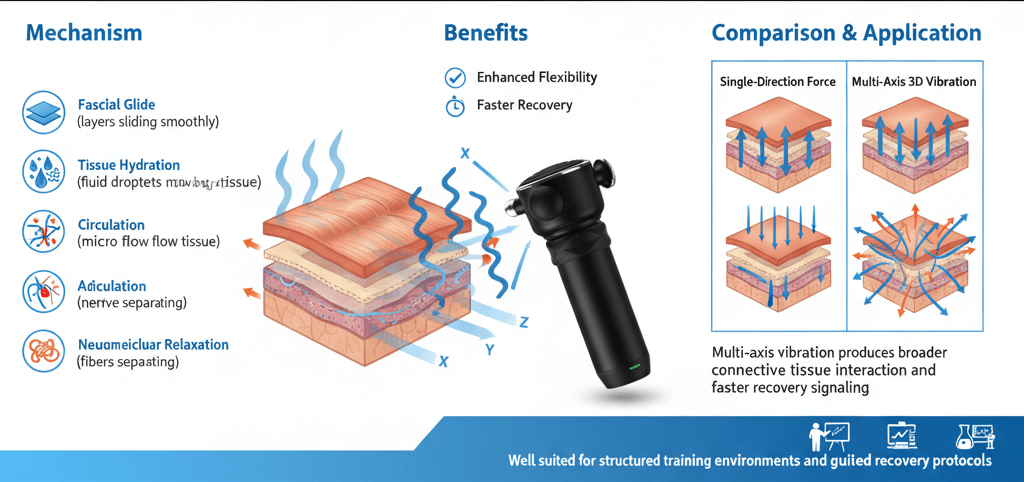
The shift toward high-frequency solutions reflects professional sports’ demand for time-efficient prep. Let’s examine why 100Hz+ is becoming the industry benchmark.
Beyond Percussion: How 100Hz+ Frequency Maximizes Kinetic Energy Transfer Without Excessive Force?
Traditional percussive therapy relies on high-amplitude impacts. Modern approaches prioritize frequency over force.
At 100Hz+, vibration energy transfers through tissues more efficiently by matching natural muscle resonance frequencies. This creates rapid cellular stimulation while keeping amplitudes below 3mm – critical for joint safety.
| Parameter | Traditional Therapy | High-Frequency 3D Vibration |
|---|---|---|
| Frequency | 5-60Hz | 100-120Hz |
| Amplitude | 8-16mm | 2-3.5mm |
| Force Transfer | Impact-based | Wave propagation |
| Tissue Penetration | Localized | Systemic |
The physics behind this involves three key mechanisms:
- Resonance coupling – 100Hz+ matches the natural vibration frequency of muscle spindles, enhancing neuromuscular activation
- Micro-oscillations – High-frequency/low-amplitude waves create fluid dynamics that improve capillary perfusion
- Energy efficiency – Lower displacement reduces motor power requirements while maintaining therapeutic effect
Commercial implementations face engineering challenges:
- Motor stability requires precision CNC-machined components to sustain 100Hz operation
- Heat dissipation becomes critical at sustained high RPM
- Battery systems must deliver consistent power output without voltage drop
The 60-Second Edge: Minimizing Pre-Workout Downtime in High-Volume Commercial Settings?
Time efficiency separates professional from consumer equipment. High-frequency systems deliver measurable workflow advantages.
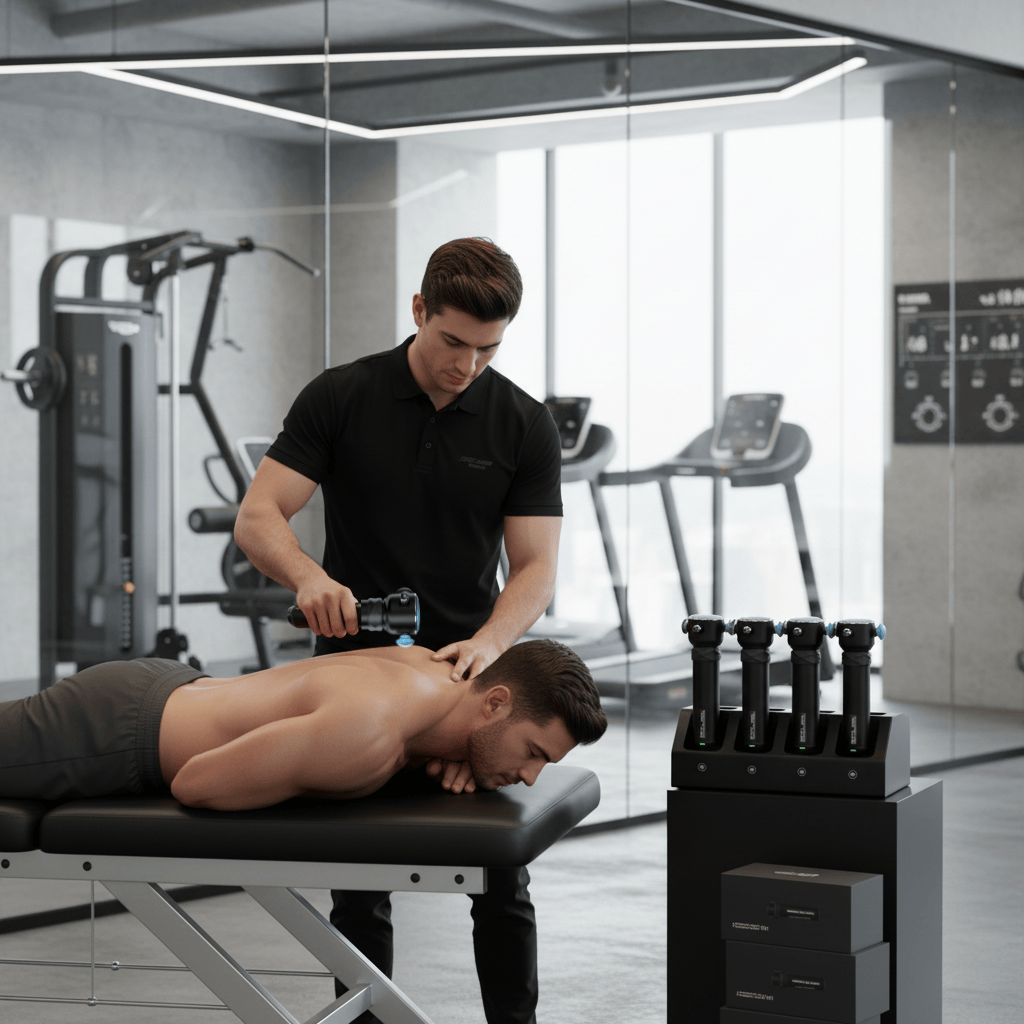
Commercial facilities gain 2-3 more client slots daily by reducing prep time from 3-5 minutes to under 60 seconds with 100Hz+ vibration. The ROI calculation becomes straightforward when multiplied across multiple stations.
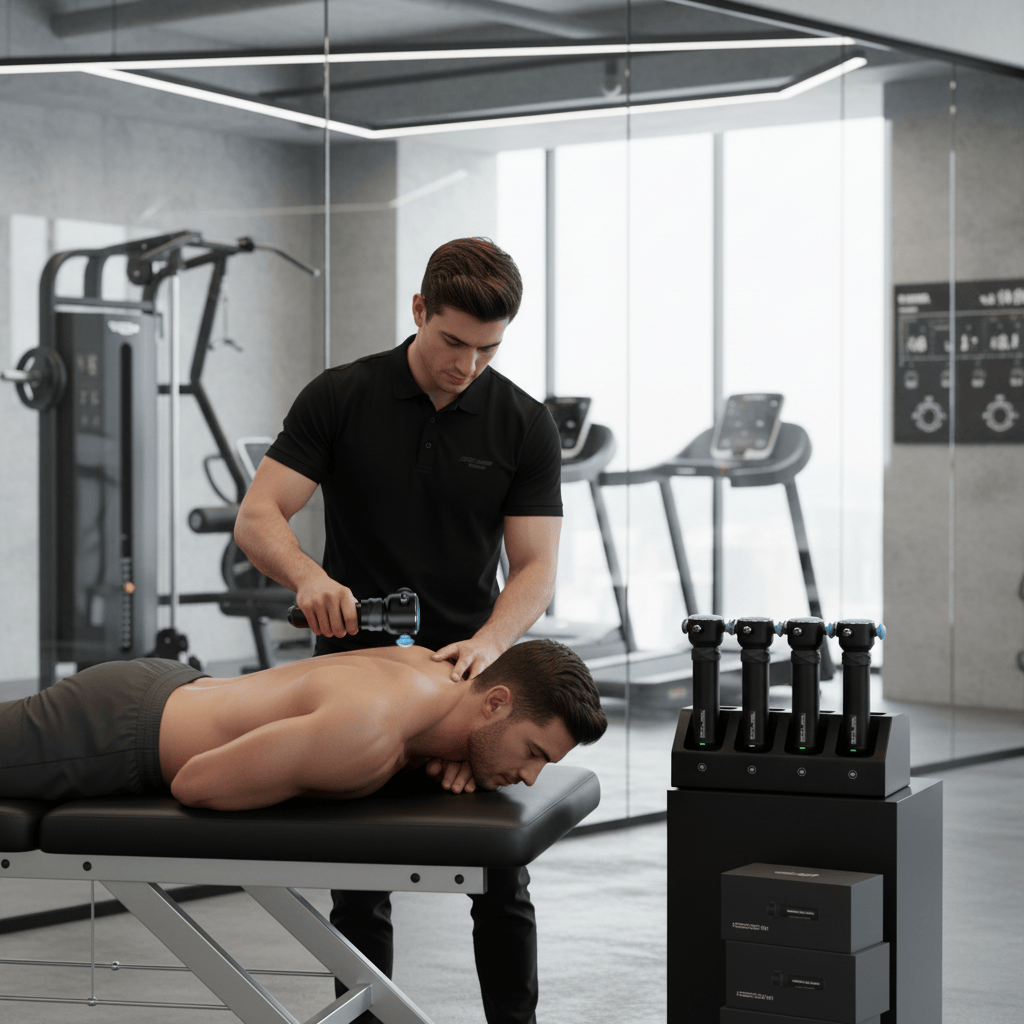
Three factors enable this efficiency:
- Neural activation speed – 100Hz stimulates Type II muscle fibers 40% faster than traditional methods
- Tissue readiness metrics – EMG studies3 show peak activation occurs within 45 seconds at optimal frequency
- Protocol standardization – Eliminates variability in manual techniques
For facility managers, the operational math is compelling:
| Metric | Traditional | 100Hz+ System | Improvement |
|---|---|---|---|
| Prep Time | 180 sec | 60 sec | 3x faster |
| Daily Throughput | 16 sessions | 24 sessions | +50% capacity |
| Monthly Revenue* | $9,600 | $14,400 | +$4,800 |
*Based on 30 days, $20/session, 8-hour operation
The hidden benefit is staff consistency – automated systems remove variability between therapists while reducing repetitive strain injuries.
Mechanical Stability at Scale: Engineering Challenges of Sustaining 100Hz+ Under Industrial Load?
Reliability separates lab prototypes from commercial-grade equipment. High-frequency operation demands robust engineering solutions.
Industrial-grade High-Frequency 3D Vibration Therapy1 devices require military-spec bearings4 and aerospace-grade alloys5 to maintain 100Hz+ operation through 10,000+ duty cycles. Consumer-grade components fail within months under professional use loads.
Critical design considerations:
| Component | Challenge | Solution |
|---|---|---|
| Motor | Brush wear at high RPM | Precious metal brushes with self-lubricating channels |
| Gearing | Harmonic vibration | Helical gear trains with dampening polymers |
| Housing | Heat accumulation | Magnesium alloy with thermal fins6 |
| Electronics | Power stability | Digital current regulation with 0.1% tolerance |
Real-world constraints reveal why few manufacturers deliver true commercial-grade systems:
- Cost barriers – Military-spec bearings increase BOM cost by 300-500%
- Manufacturing precision – Sub-10micron tolerances require CNC machining7, eliminating low-cost casting options
- Testing protocols – 1,000-hour accelerated life testing adds 6-8 weeks to development cycles
The market bifurcation is clear: consumer devices optimize for price at 50-80Hz, while professional systems invest in 100Hz+ reliability. This explains the 5-8x price differential between market segments.
Conclusion
High-Frequency 3D Vibration Therapy1 at 100Hz+ represents the convergence of sports science and precision engineering. For facilities prioritizing throughput and athlete readiness, the technical advantages translate directly to operational and financial benefits.
-
Explore this link to understand how High-Frequency 3D Vibration Therapy can enhance muscle preparation and recovery. ↩ ↩ ↩
-
Learn about kinetic energy transfer and its role in optimizing muscle therapy for better performance. ↩
-
Explore EMG studies to see how they measure muscle activation and inform therapy protocols. ↩
-
Learn about the critical role of military-spec bearings in ensuring the reliability of high-frequency therapy devices. ↩
-
Learn about the advantages of using aerospace-grade alloys in high-frequency therapy devices for durability. ↩
-
Discover how thermal fins enhance the performance and longevity of high-frequency therapy devices. ↩
-
Explore the importance of CNC machining in producing precise components for high-frequency therapy devices. ↩